Mostrando entradas con la etiqueta mars. Mostrar todas las entradas

miércoles, 6 de mayo de 2020

Esta es la prueba de la existencia del agua en Marte


Los investigadores han pasado décadas buscando evidencias de agua en Marte. A medida que la tecnología se ha ido desarrollado, han salido a la luz más pruebas de que los ríos, lagos e incluso los océanos fueron una vez abundantes en el planeta rojo.

El Marte moderno es helado y polvoriento y es poco probable que tenga mucha agua líquida en la superficie, si es que la tiene, en primer lugar. Sin embargo, hace miles de millones de años, Marte era más cálido y podría haber tenido suficiente agua líquida para sustentar la vida. 

Ahora los científicos han descubierto la primera evidencia de un río en Marte que fluyó a través del planeta rojo durante más de 100.000 años.  

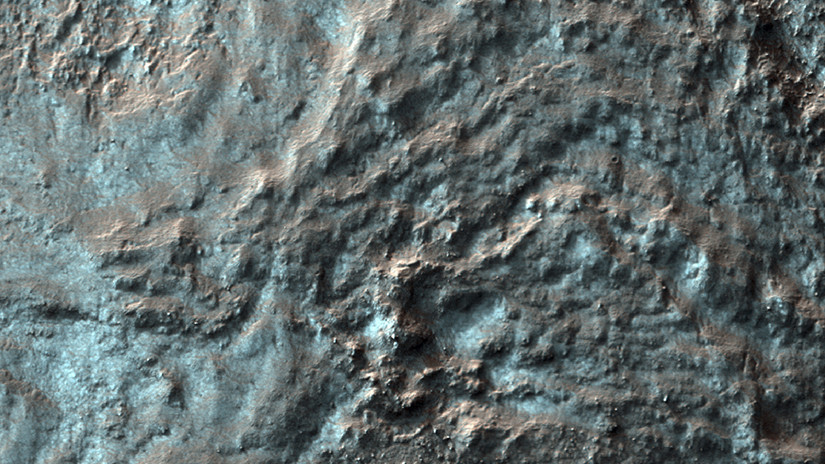
El equipo examinó las imágenes tomadas por el Experimento Científico de Imágenes de Alta Resolución de la NASA (HiRISE) de la nave espacial Mars Reconnaissance Orbiter. Las imágenes fueron tomadas dentro del enorme cráter de impacto Hellas en el hemisferio sur de Marte, uno de los cráteres de impacto más grandes del sistema solar.

Las imágenes detalladas revelaron que el cráter fue formado por ríos hace más de 3.700 millones de años. Eso es más o menos el mismo tiempo en que la vida estaba empezando a comenzar en la Tierra.

Las marcas permanentes dejadas en las caras expuestas de los acantilados de más de 200 metros de altura revelan que el río era un profundo y rápido torrente de agua que existía todo el año. Las marcas en la roca son idénticas a las que se ven en la Tierra cuando el agua pasa por la roca durante largos períodos de tiempo. Se cree que el río se movía constantemente y creaba bancos de arena similares al Rin, o a otros ríos del norte de Italia. 

Las imágenes también muestran que los procesos fluviales que formaron estas rocas ocurrieron durante un período de tiempo muy largo.

"Los ríos que formaron estas rocas no fueron un evento aislado, sino que probablemente estuvieron activos durante decenas o cientos de miles de años", explicó Joel Davis, uno de los autores de la investigación.


Esto prueba que Marte tenía abundante agua líquida y una atmósfera estable capaz de soportar la vida hace unos 3.700 millones de años, cuando el sistema solar estaba en su infancia. 

"Nunca hemos visto un afloramiento con esta cantidad de detalles en el que definitivamente podemos decir que es muy antiguo. Esta es una pieza más del rompecabezas en la búsqueda de vida anterior en Marte, proporcionando una novedosa visión de cuánta agua ocupaban estos antiguos paisajes", agregó. 

Esta evidencia refuerza la esperanza de que las rocas sedimentarias de este período podrían ser ideales para la búsqueda de evidencia de vida pasada en Marte.

"Aquí en la Tierra, las rocas sedimentarias han sido utilizadas por los geólogos durante generaciones para imponer restricciones a las condiciones que existían en nuestro planeta hace millones o incluso miles de millones de años", explicó el coautor William McMahon en una declaración.


"Ahora tenemos la tecnología para extender esta metodología a otro planeta terrestre, Marte, que alberga un antiguo registro de rocas sedimentarias que se extiende aún más atrás en el tiempo que el nuestro", añadió McMahon.

Los hallazgos se publicaron en la revista Nature Communications.

lunes, 4 de mayo de 2020

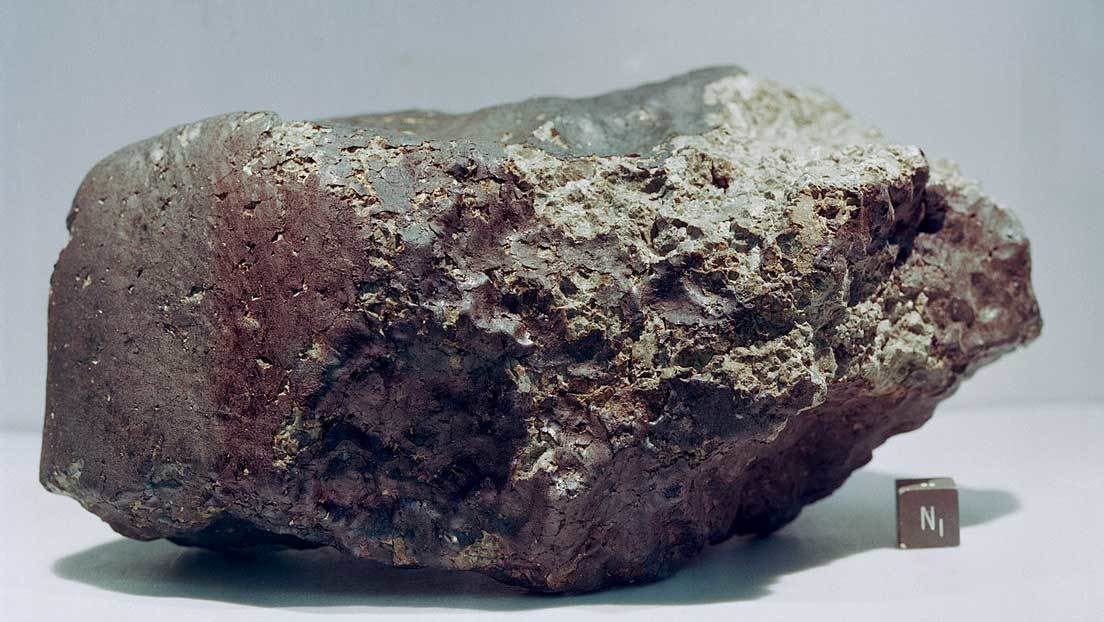
Hallan nitrógeno atrapado en los compuestos orgánicos de un meteorito marciano


El componente previamente inadvertido hace referencia a un planeta húmedo y apto para albergar vida hace 4.000 millones de años.

Los partidarios de la idea de que hay vida en Marte han obtenido un nuevo argumento a favor de esta hipótesis. Un grupo de científicos de Japón encontró en muestras del meteorito de origen marciano Allan Hills 84001 un componente que pasó desapercibido durante décadas: nitrógeno atrapado en la roca.

El microscopista Atsuko Kobayashi, uno de los autores del hallazgo, destaca que el nitrógeno es un elemento crucial para la vida tal y como la conocemos, al igual que lo es el carbono, también presente en la pieza. En un comentario concedido a la revista Newsweek, el científico comentó que trabajó dos décadas con ese meteorito, un objeto "famoso, con cientos de artículos publicados sobre él".

La NASA registra 174 sismos en Marte: ¿qué los provoca y por qué es importante su detección?

El material orgánico con el nitrógeno incluido estuvo en los minerales carbonatos del meteorito, detalla a su vez un comunicado difundido por el Instituto de Tecnología de Tokio. Exámenes previos establecieron que estos minerales se habían formado hace aproximadamente 4.000 millones de años, y las sustancias incrustadas debían de ser al menos de la misma época.

El meteorito es fruto de un impacto sobre la superficie de Marte por parte de un asteroide hace unos 15 millones de años. Posteriormente, este cuerpo celeste pasó la mayor parte del tiempo en el espacio antes de precipitarse sobre la Tierra. Una expedición estadounidense lo encontró en 1984 en la Antártida, y desde entonces esta pieza de roca marciana generó bastantes conjeturas sobre la "actividad biogénica" en el planeta rojo.

Puesto que los minerales de carbonatos normalmente se sedimentan del agua subterránea (algo que se conoce por la mineralogía terrestre), el hallazgo apunta a un Marte joven húmedo y rico en compuestos orgánicos, un entorno que podría ser favorable para el inicio de la vida, estiman los investigadores nipones.

"Las moléculas orgánicas son aquellas que contienen cadenas y anillos de átomos del carbono unidos, como los que utiliza la vida [en la Tierra]", añadió Kobayashi. "A menudo contienen átomos de nitrógeno, particularmente en los aminoácidos que forman las proteínas, así como en el ADN y el ARN", explicó.

En opinión del investigador, la detección del nitrógeno sugiere que el Marte joven no era no tan rico en oxígeno como el actual. "Nuestra química de nitrógeno nos dice que la atmósfera no tenía mucho oxígeno cuando se formaron estas moléculas, lo cual es una información nueva", señaló el experto.

El descubrimiento a finales del siglo XX de compuestos orgánicos en meteoritos marcianos y, más recientemente, en la corteza de Marte abrieron un debate sobre su origen. Todavía se sabe poco de la edad que tienen, cuán ampliamente están distribuidos y qué eslabón ocupan en la cadena bioquímica.

lunes, 13 de agosto de 2018

Putting the ethics into planetary protection

In the coming decades, as we gear up for a more in-depth search for life on Mars, as well as visits to potentially habitable ocean moons in the outer Solar System, should scientists start addressing the ethical concerns of accidentally contaminating these worlds with Earthly microbes, as well as the scientific implications? That's the question posed by a trio of scientists who are arguing for a shake-up in how we think about planetary protection.

If there is life on Mars, or in the waters of Europa or Enceladus, then we risk contaminating it with terrestrial microbes before we can even get the chance to discover that life. Despite our best efforts, no mission goes into space completely sterile, but there are requirements: the Outer Space Treaty, which was signed by all space-faring nations in 1967, stipulates that every effort must be made to protect other worlds from contamination. The Committee on Space Research (COSPAR) has guidelines that state that any mission designed to look for life on other worlds must not have a probability greater than 1-in-10,000 that a single microbe carried on board will contaminate potential extraterrestrial habitats.

The requirement is dictated by the need to ensure the scientific integrity of the discovery of life. How could we be sure we have found life native to another world if we have already contaminated it with Earthly microbes? There is, however, another aspect to planetary protection that tends to be overlooked, which is that the potential alteration of alien biospheres in the face of invasive terrestrial microbes is also an ethical issue.

Currently, the only potentially life-bearing world that could have been contaminated by microbes hitchhiking on a spacecraft is Mars. In 2012, researchers catalogued 298 strains of extreme bacteria that were able to survive the sterilization process in European Space Agency clean rooms, and it is expected that there are dormant terrestrial microbes on Mars today, although it is not suspected that any active contamination has yet taken place.

However, that could change if humans land there, or if we send spacecraft to venture into the oceans of the icy moons of the outer Solar System.

Therefore, it's time to reopen the debate about the risks of 'forward contamination' and its ethical implications, say Brent Sherwood and Adrian Ponce of the Jet Propulsion Laboratory (JPL), and Michael Waltemathe of Ruhr-Universität Bochum in Germany.

"What motivated us was what I call the pedigree and the provenance of the 1-in-10,000 number," says Sherwood, who is Program Manager for Solar System science mission formulation at JPL . "By pedigree I mean, where did it come from, and by provenance I mean, how has it been curated since it was written down? My co-authors and I find it unsatisfying, partly because modern biology is a moving target, and also partly because we are now entering an era where we will be exploring other worlds with vast amounts of water."

Preventing forward contamination

The current forward contamination requirement has a long history. Its story dates back to 1963, when JPL's Leonard Jaffe first presented the number in a study that was based on two rationales. The first was the likelihood that three-quarters of all life-detecting missions to Mars would fail to return useful data (this was back in the 1960s, when spaceflight was new and mission failures were common), and the second was that the chance of contaminating Mars with robotic spacecraft is much less than if humans landed on the red planet.

Subsequent studies categorized missions by type (are they landers or rovers, and are they designed to detect life?) as well as by a mission's target (is the spacecraft going to a possibly life-bearing world such as Mars or Europa, or a dead world like Mercury?). These subsequent studies typically still conclude that a probability of 1-in-10,000 is the most reasonable requirement. Yet the more we learn about the potential for life not only on Mars but also the ocean moons of the outer Solar System, and the more we discover about extremophile survivability and microbial interdependences - with the former arguing for a more stringent requirement and the latter for a more lax requirement, says Sherwood - the more these studies look outdated.

It's not just the danger of foiling our own life-detection experiments that concerns Sherwood and his colleagues. At numerous conferences, and now in a paper published in the journal Space Policy, Sherwood and his colleagues raise the issue of ethics.

"Maybe there is life out there, but can we learn about it without damaging it, and is it up to us to protect it? What obligations are we under?" asks Sherwood. "The entire history of the discussion of the forward contamination requirement has been motivated only by protecting our ability to do science in the future. What it's missing is a discussion about protecting the biosphere of another world because it may not be ours to mess up, which is the ethical argument."

Risk assessment

In their paper, the scientists cite two examples where scientific endeavors with societal and ethical consequences had risk assessments taken and a decision made as to whether to proceed. The first was the scientific debate over the test of the first thermonuclear bomb in 1952. One concern at the time was that the explosion might ignite a chain reaction in our atmosphere, incinerating it and all life on the planet. Because of the classified nature of nuclear weapons development, these deliberations took place in secret and the decision was never placed in the wider world's hands.

The second example is the switching on of two powerful particle accelerators, the Relativistic Heavy Ion Collider in the USA and the Large Hadron Collider on the France-Switzerland border. In both cases it was perceived by some that there could be a tiny risk that the particle collisions could produce a black hole that could swallow the Earth. Activists ultimately took the governing bodies of the particle accelerators to court to try and prevent the switch-on of the particle accelerators.

In each case, the solution was decided by means that Sherwood would like to avoid - in secret or in a court of law. There is a case to argue that scientific dilemmas with ethical implications should be open for the whole world to debate, just like how discussions over the use of genetically modified foods or artificial intelligence have been placed on the global stage. Furthermore, Sherwood and his co-authors are calling on not just scientists, but also the public and non-technical experts, to discuss the risks of contaminating another world with terrestrial microbes and determine what an acceptable way of managing those risks would be.

"The discussion needs to include people who are not technical, it needs to be open and it needs to be ongoing, because there is no such thing as a final answer to any of this," says Sherwood. By that, Sherwood is referring to how our understanding of biology, and astrobiology is growing so rapidly that it is beginning to outpace the evolution of our planetary protection policies. Given the length of time it takes to propose, plan and launch a planetary mission, the astrobiological sands could very well have shifted in the decade or so between planning and building a spacecraft, and launching and conducting its mission.

"Part of our motivation is the fear - that's a strong word, sorry - that having this conversation downstream would be more painful and expensive than having it upstream," Sherwood tells Astrobiology Magazine. "Because these are multi-decade endeavors in planetary science, the people who make the policy decisions today won't even be around when the missions occur, but the people who will inherit the societal consequences and on whose conscience it will weigh if we stumble or make a mistake aren't even at the table yet. Who speaks for them?"

Communication

A recent report into planetary protection protocols from the National Academies of Science, Engineering and Medicine devoted just a few paragraphs to the discussion of the ethical implications. In the report, the committee of authors recognize that planetary protection and the resulting ethical issues are intertwined, and that their complex nature would require new policies. The report also states, however, that "dialogue on expanding planetary protection ethics has not advanced sufficiently to permit the committee to make relevant findings and recommendations. Nor did the committee believe it had the mandate to study specifically the implications of an expanded ethical approach to planetary protection... Periodic updates of ethical implications could be a way to convey norms to the international public and private space community as concerns arise; formal COSPAR policy would presumably follow."

Despite the National Academies report, Sherwood already has a mechanism in mind for tackling the ethical considerations before they become a more serious concern. He sees two stages, with the first stage being to get the problem out into the open and communicate to the world what can be done, how the risks could be managed, what our limitations are and what the 1-in-10,000 number means. This would help provide context for the global discussion to then move to the second stage, which is deciding from the options available what should be done.

Communicating those options correctly is still a problem, says Sherwood, who highlights one particular feature in a concept for a spacecraft that could one day land on the icy wastes of Jupiter's moon Europa, which hosts a global ocean somewhere below the ice. Over aeons, Europa is resurfaced and eventually, as part of this resurfacing process that sees the gradual churning of surface ice, any lander would find itself subsumed by the ice and gradually work its way down towards the ocean, where there could potentially be life.

"There would be a subsystem inside the spacecraft that, when the mission is over, will incinerate the innards, which are the parts of the spacecraft that we would be unable to be sterilize before launch," Sherwood tells Astrobiology Magazine. "It's a very subtle, sophisticated response to the forward contamination requirement, yet it is not clear how widespread the understanding of this approach even is yet. It starts with communication."

Given that ethical values can vary from organization to organization in the same country, never mind from country to country, there is the potential for such discussion to involve heated debate, with clashes of viewpoints. Ultimately, some people could be left disappointed by the conclusion reached by the majority, but one area that remains unclear is who ultimately makes that final decision based on the arguments presented as part of the debate.

"I don't have an answer to that!" he admits. "Going back to the precedent of the particle accelerators, the decisions were relegated by the courts to the jurisdictions in which the facilities were built."

The organization that has the ultimate say over space launches is the launching authority in a given country, per the Outer Space Treaty. The launching authority has responsibility for ensuring that the launch is safe, is not carrying any toxic materials that could harm life on Earth in the event of a launch failure, and is not a danger to other satellites and spacecraft already in orbit. In the United States, says Sherwood, the Federal Aviation Administration (FAA) has ultimate control over what launches and what doesn't, but the FAA does not have the personnel to assess the risks for planetary protection.

"How could they make a decision?" asks Sherwood rhetorically. "So, there's sort of a mechanism in place, but it's not a complete mechanism. I think all of these issues regarding who gets the final say and how would that happen need to be decided, which again is a good reason to have the discussion. It may be that the rest of the world doesn't even care if we interfere with an alien ecosystem, but our point is not that people will care, it's that people might care, and until we ask we won't know."

sábado, 5 de mayo de 2018

Detalles de la nueva misión de la NASA al interior del planeta rojo


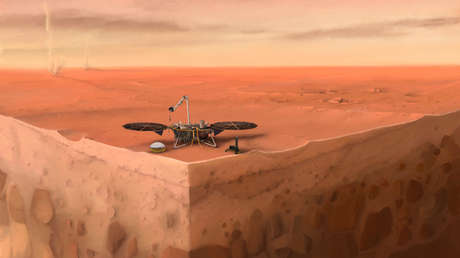
El módulo InSight, diseñado para investigar el interior del planeta rojo, será lanzado este sábado desde la Base Vandenberg, en California.

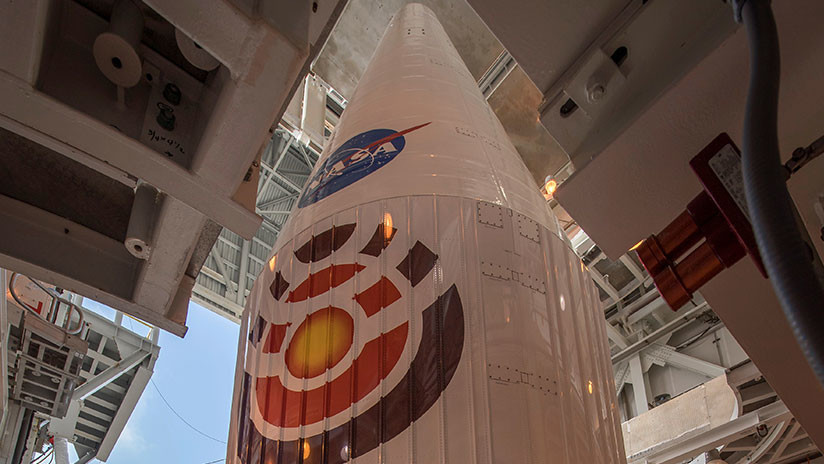
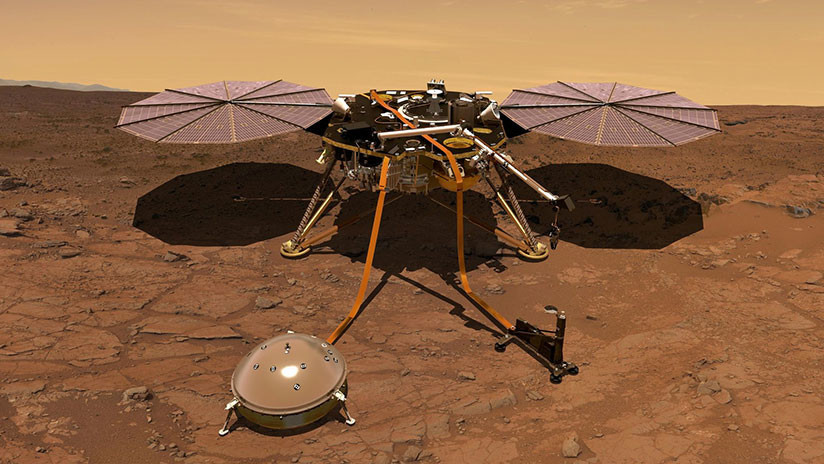
La NASA lanzará este sábado rumbo a Marte la sonda InSight  para estudiar la actividad sismológica y los flujos de calor en el interior del planeta rojo, informa la agencia espacial estadounidense. El lanzamiento está previsto para las 4:05 de hora local (11:05 GMT) desde la Base de la Fuerza Aérea Vandenberg, cerca de Lompoc, California.

El investigador principal de inSight, Bruce Banerdt, sostiene que esta será la primera misión a Marte especialmente concebida "para investigar su interior" que, a diferencia de la superficie marciana, de su atmósfera e ionosfera, nunca se ha estudiado.

Se espera que el aparato llegue al planeta rojo el 26 de noviembre de 2018. A lo largo de dos años, la estación —con un sismómetro a bordo— estudiará la estructura interna del planeta, registrando sus sismos, y usará sondas para investigar los flujos de calor.

"Al estudiar Marte podremos saber más sobre la Tierra, Venus, Mercurio, la Luna o exoplanetas alrededor de otras estrellas", señala el especialista.

Este módulo también llevará a cabo un experimento radiocientífico valiéndose de "una radio de la nave espacial para medir pequeñas variaciones en la oscilación del Polo de Marte y saber así más de la estructura y composición del núcleo".

El módulo InSight consta de un escudo que absorberá el calor cuando el aparato penetre en la atmósfera del planeta rojo, después de lo cual desplegará su paracaídas que garantizará la estabilidad y reducirá la velocidad de la sonda espacial.

"InSight será la primera misión donde un aparato recoge instrumentos de la cubierta del módulo y los coloca en la superficie del Marte", recalca Jaime Singer, responsable principal para sistema de despliegue de instrumentos del módulo. La expertoa compara esta tecnología con "la garra de la máquina de los peluches", explicando que el aparato funcionará de la misma forma, automáticamente, pero sin "palanca de mando".

El módulo fijará un sismómetro en la superficie y lo cubrirá con un escudo termal para proteger el instrumento de factores externos. Además, el dispositivo para investigar y medir los flujos de calor taladrará el suelo para obtener los datos.

La NASA fijó un plazo flexible para el lanzamiento del módulo entre el 5 de mayo y el 8 de junio de este año, para estar prevenidos por si se presentan condiciones adversas.

La NASA lanza InSight para ver cómo es Marte 'por dentro'


El lanzamiento tuvo lugar desde la Base Vandenberg de la Fuerza Aérea, en California, EE.UU., y entre sus objetivos figura el estudio de la actividad sismológica en el planeta rojo.

La NASA ha lanzado este sábado a Marte la sonda InSight desde la Base de la Fuerza Aérea Vandenberg, cerca de Lompoc, California, con el objetivo de estudiar la actividad sismológica en el planeta rojo.

Se espera que el aparato llegue al planeta rojo el 26 de noviembre de 2018. A lo largo de dos años, la estación —con un sismómetro a bordo— estudiará la estructura interna del planeta, registrando sus sismos, y usará sondas para investigar los flujos de calor.

Detalles de la misión

El investigador principal de inSight, Bruce Banerdt, sostiene que esta será la primera misión a Marte especialmente concebida "para investigar su interior" que, a diferencia de la superficie marciana, de su atmósfera e ionosfera, nunca se ha estudiado.

Este módulo llevará a cabo un experimento radiocientífico valiéndose de "una radio de la nave espacial para medir pequeñas variaciones en la oscilación del Polo de Marte y saber así más de la estructura y composición del núcleo".

El módulo InSight consta de un escudo que absorberá el calor cuando el aparato penetre en la atmósfera del planeta rojo, después de lo cual desplegará su paracaídas que garantizará la estabilidad y reducirá la velocidad de la sonda espacial.

"InSight será la primera misión donde un aparato recoge instrumentos de la cubierta del módulo y los coloca en la superficie del Marte", recalca Jaime Singer, responsable principal para sistema de despliegue de instrumentos del módulo. La experta compara esta tecnología con "la garra de la máquina de los peluches", explicando que el aparato funcionará de la misma forma, automáticamente, pero sin "palanca de mando".

El módulo fijará un sismómetro en la superficie y lo cubrirá con un escudo termal para proteger el instrumento de factores externos. Además, el dispositivo para investigar y medir los flujos de calor taladrará el suelo para obtener los datos.

lunes, 2 de abril de 2018

NASA looks into robot bees for Mars exploration


NASA could get buzzy on Mars as it funds research into building a swarm of Marsbees that could take flight on the Red Planet.

Robots modeled after Earth bees could one day zip across Mars.

The rocky landscape on Mars is hell on rover wheels, so NASA researchers are considering ways to explore the Red Planet by taking flight there instead. The space agency is looking into developing a swarm of robotic bees called Marsbees.

Each Marsbee would be about the size of a bumblebee, but with larger wings the size of a cicada's. The bees would launch from a mobile base that acts as a communications hub and recharging station. 

"Our preliminary numerical results suggest that a bumblebee with a cicada wing can generate sufficient lift to hover in the Martian atmosphere," writes Chang-kwon Kang, an aerospace engineer at the University of Alabama, Huntsville. 

Robo-bees

Walmart wants to make autonomous robotic bees a reality'Plan Bee' drone can pollinate flowers when real bees can't

Kang's team plans to work with a Japanese group that will build and test a robot designed specifically to operate on Mars. The researchers in Japan have already developed what they call a "hummingbird micro-air vehicle" that can fly here on Earth. They plan to test the hummingbird robot in a vacuum chamber to simulate Mars' atmosphere.

This concept art shows how Marsbees could work with a base station.

C. Kang

NASA announced a round of investments last Friday for 25 early-stage technology projects as part of its NASA Innovative Advanced Concepts program. Marsbees is one of those concepts, which also includes a balloon locomotion idea and self-assembling space telescope swarms

NASA says it's looking for technologies with "the potential to transform future human and robotic exploration missions." The Phase 1 award amounts to about $125,000 (£89,000, AU$163,000) over nine months and is aimed at refining the concept and studying its feasibility.

With human exploration of Mars a long way off, we rely on robotic surrogates to gather information about the Red Planet. NASA has had great success with its Mars rovers, particularly Curiosity and Opportunity, but they are limited in the amount of ground they can cover. That's where flying robots like the Marsbee could come in. NASA is already considering the idea of a drone-like robotic flying machinefor studying Saturn's moon Titan.

The Marsbees idea is still in the very early stages, but it's intriguing. The robotic bees could potentially explore parts of Mars a land-based rover could never reach. 


domingo, 4 de marzo de 2018

"Mars' Scientist Accuses NASA Curiosity Team of Cover Up of Alien-Life Discovery"

The scientist says he'll 'prove NASA cover-up over alien life on Mars' with bombshell report which he claims proves NASA has covered up evidence of alien life on Mars. Dr Barry DiGregorio said the agency's space explorer - dubbed Curiosity - has images of what may be trace fossils. DiGregorio is author of Mars The Living Planet and The Microbes of Mars, both support the data provided by the 1976 Viking biology experiment known as the Labeled Release experiment designed by Gilbert V. Levin. These books conclude that Levin's Mars LR experimensts were the first to discover evidence for microbial activity in the soil of Mars.

Star-shaped and swallowtail-shaped tiny, dark bumps in fine-layered bright bedrock of a Martian ridge are drawing close inspection by NASA's Curiosity Mars rover.

This set of shapes looks familiar to geologists who have studied gypsum crystals formed in drying lakes on Earth, but Curiosity's science team is considering multiple possibilities for the origin of these features on "Vera Rubin Ridge" on Mars.

One uncertainty the rover's inspection may resolve is the timing of when the crystal-shaped features formed, relative to when layers of sediment accumulated around them. Another is whether the original mineral that crystallized into these shapes remains in them or was subsequently dissolved away and replaced by something else. Answers may point to evidence of a drying lake or to groundwater that flowed through the sediment after it became cemented into rock.

The rover team also is investigating other clues on the same area to learn more about the Red Planet's history. These include stick-shaped features the size of rice grains, mineral veins with both bright and dark zones, color variations in the bedrock, smoothly horizontal laminations that vary more than tenfold in thickness of individual layers, and more than fourfold variation in the iron content of local rock targets examined by the rover.

"There's just a treasure trove of interesting targets concentrated in this one area," said Curiosity Project Scientist Ashwin Vasavada of NASA's Jet Propulsion Laboratory, Pasadena, California. "Each is a clue, and the more clues, the better. It's going to be fun figuring out what it all means."

Vera Rubin Ridge stands out as an erosion-resistant band on the north slope of lower Mount Sharp inside Gale Crater. It was a planned destination for Curiosity even before the rover's 2012 landing on the crater floor near the mountain. The rover began climbing the ridge about five months ago and has now reached the uphill, southern edge. Some features here might be related to a transition to the next destination area uphill, which is called the "Clay Unit" because of clay minerals detected from orbit.

The team drove the rover to a site called "Jura" in mid-January to examine an area where - even in images from orbit - the bedrock is noticeably pale and gray, compared to the red, hematite-bearing bedrock forming most of Vera Rubin Ridge.

"These tiny 'V' shapes really caught our attention, but they were not at all the reason we went to that rock," said Curiosity science-team member Abigail Fraeman of JPL. "We were looking at the color change from one area to another. We were lucky to see the crystals. They're so tiny, you don't see them until you're right on them."

The features are about the size of a sesame seed. Some are single elongated crystals. Commonly, two or more coalesce into V-shaped "swallowtails" or more complex "lark's foot" or star configurations. "These shapes are characteristic of gypsum crystals," said Sanjeev Gupta, a Curiosity science-team member at Imperial College, London, who has studied such crystals in rocks of Scotland. Gypsum is a form of calcium sulfate. "These can form when salts become concentrated in water, such as in an evaporating lake."

DiGregorio, from University of Buckingham, an expert is ichnology - a science which combines the study of dissolution cavities left behind by organisms along with their tracks, trails and burrows, said: "They look remarkably similar to Ordovician trace fossils I have studied and photographed here on Earth. "If not trace fossils, what other geological explanations will NASA come up with?" He says the trace fossils represent signs of "soft bodies creatures" which once roamed the Red Planet.

DiGregorio has now accused NASA of a cover up and said the space agency could be witholding information due to its plans to send humans to Mars in the 2030s. He told Daily Star Online: "Put it this way, these images, these figures, have not been seen on Mars to date. "One of the things that grabbed me immediately was the expediency that NASA left the area of such a mission. So when I started looking, it wasn't just the objects that were attached the outside, what they are calling sticks.

"If you look at the images more closely, the sticks merge into the host rock, this actually has features in it that are reminiscent of trace fossils.

jueves, 28 de diciembre de 2017

La nieve 'navideña' de Marte, en espléndidas imágenes de la NASA


mars.jpl.nasa.gov

Sí, en el planeta rojo también hay invierno y nieve. Y es impresionante.

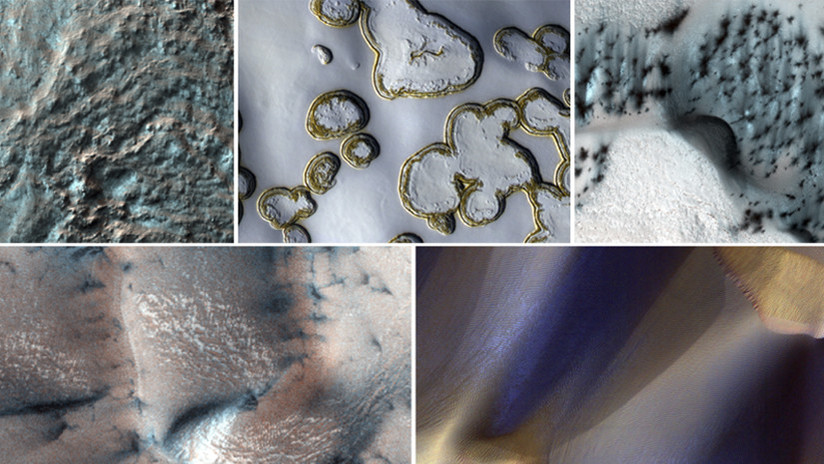
La NASA divulgó imágenes, tomadas recientemente por la sonda Mars Reconnaissance Orbiter, que muestran la atmósfera 'navideña' que reina estos días en Marte. En las fotos, los paisajes del planeta rojo aparecen cubiertos de nieve.

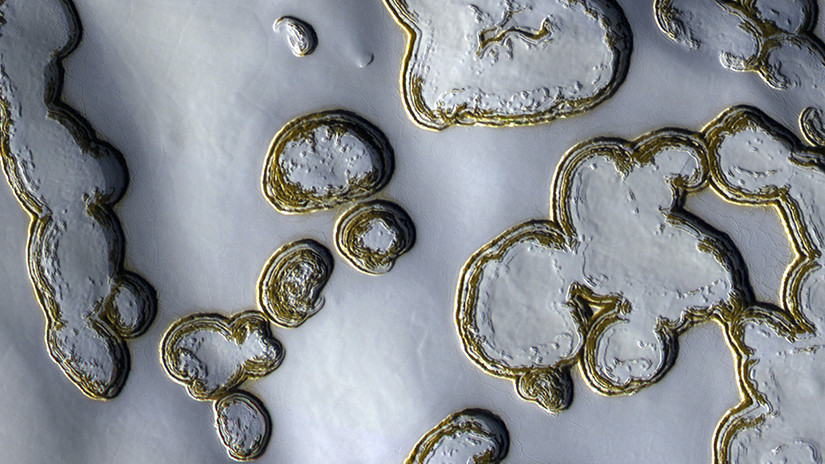
Con las temperaturas más frías de finales de otoño, el dióxido de carbono de la atmósfera marciana se condensa en hielo y se posa en la superficie para una larga siesta de invierno.

mars.jpl.nasa.gov

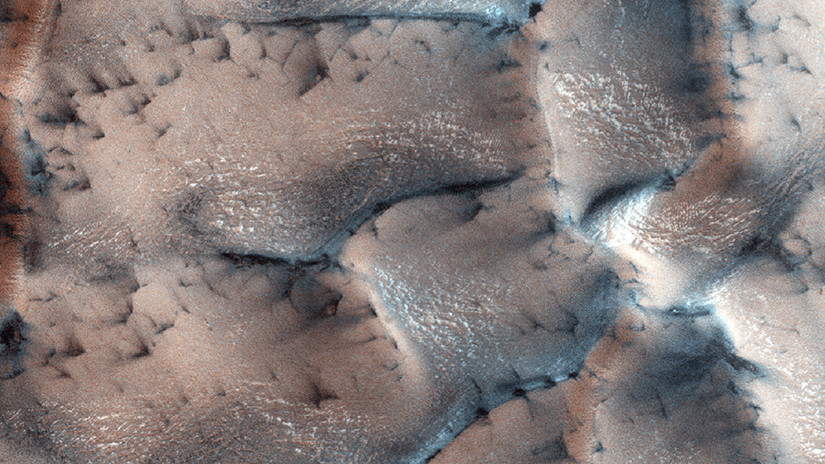
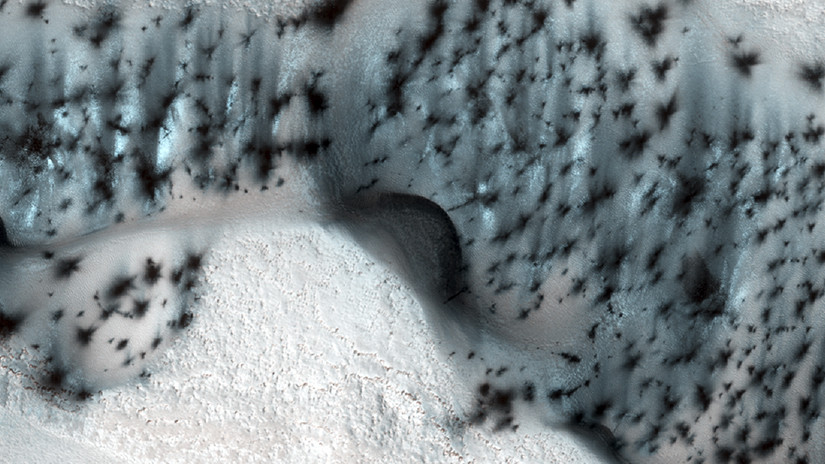
Las dunas de Marte se cubren de grietas debajo de la nieve, por lo cual se forman inusuales dibujos en la arena.

mars.jpl.nasa.gov

La nieve en el polo sur del planeta rojo se mantiene durante todo el año gracias a las bajas temperaturas. La siguiente foto refleja las dunas en la zona Aonia Terra del hemisferio sur cubiertas por las heladas de dióxido de carbono.

mars.jpl.nasa.gov

Los 'pozos' de Marte contrastan con la nieve de dióxido de carbono. Los más pequeños, en el centro, son del tamaño de un estadio.

mars.jpl.nasa.gov

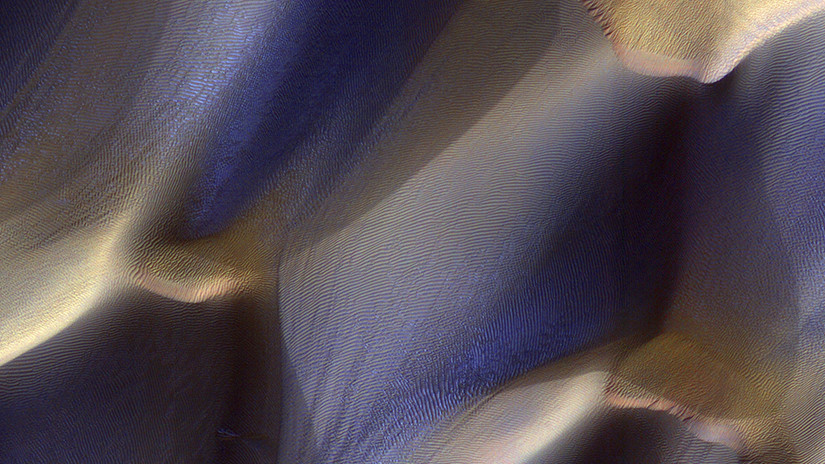
Así lucen las dunas heladas del polo norte marciano, cubiertas con arena que aparece con el aumento de las temperaturas en el planeta.

mars.jpl.nasa.gov

viernes, 1 de septiembre de 2017

Voluntarios de la NASA encuentran 'arañas' marcianas

Reuters

Las 'arañas' aparecen en el polo sur de Marte al inicio de la estación cálida.

Voluntarios que colaboran con los investigadores de la Universidad de Oxford (Reino Unido) descubrieron nuevas estructuras arácnidas en la superficie de Marte, informa 'Science Daily'. Las estructuras fueron halladas en una parte del planeta que los científicos han denominado como 'Los depósitos estratificados del Polo Sur'.

En la Tierra no se observan formaciones similares. Las 'arañas' aparecen en el polo sur de Marte al inicio de la estación cálida, cuando la luz solar calienta el suelo cubierto de hielo seco de dióxido de carbono. Ese hielo se convierte en gas y sale a la superficie creando estos enigmáticos patrones en el suelo de Marte.

Los voluntarios estudiaron más de 20.000 imágenes de la superficie del Planeta Rojo, en las que también encontraron formaciones de tierra del tipo conocido como 'terreno de queso suizo'.

El descubrimiento fue realizado por voluntarios que trabajan para el proyecto Planet Four: Terrains. El proyecto es uno de muchos del portal de cienciaZooniverse, que está financiado por la NASA y que permite a cualquier ciudadano participar en proyectos científicos.

domingo, 16 de julio de 2017

Por culpa del Sol": La NASA estará más de una semana sin contacto con sus misiones en Marte

"Por culpa del Sol": La NASA estará más de una semana sin contacto con sus misiones en Marte (VIDEO)

Publicado: 16 jul 2017 05:57 GMT

Marte está a punto de 'esconderse' justo detrás del Sol, lo que dejará a la NASA sin contacto con las misiones que se mantiene en el planeta rojo y en su órbita.

NASA


Esperamos una degradación grave de la comunicación y no queremos correr el riesgo de que una de nuestras naves espaciales obedezca a una orden distorsionada", asegura Chad Edwards, gerente del Centro de las Redes de Transmisiones con Marte del Laboratorio de Propulsión a Reacción de la NASA.

En este sentido, la NASA no enviará ninguna órden a sus tres orbitadores que mantiene alrededor de Marte ni a los dos vehículos 'Mars rover' que se encuentran en la superficie del planeta rojo.

La medida se aplicará entre el 22 de julio y el 1 de agosto, durante la alineación de la Tierra, el Sol y Marte.

Según reza el título del comunicado de la NASA que informa de la decisión, la moratoria en el envío de órdenes a Marte será "por culpa del Sol".

lunes, 12 de junio de 2017

¿Hablas extraterrestre?: Cómo las redes sociales descifraron un 'mensaje alienígena'


¿Y si un día recibimos un mensaje extraterrestre? Un científico pone a prueba a los habitantes de la Tierra para averiguar si están preparados.

El año pasado, el astrofísico René Heller organizó un experimento: imitó la recepción de un mensaje alienígena y empleó las redes sociales para invitar a descifrarlo, recoge 'New Scientist'.

Heller, científico del Instituto Max Planck para la Investigación del Sistema Solar de Gotinga (Baja Sajonia, Alemania), fingióser un extraterrestre que podía contar y difundió alrededor de dos millones de números en código binario —compuesto por ceros y unos— que escondían diversa información, incluida una imagen de su presunto sistema planetario natal.

Una comunicación 'alienígena'

Una parte del comunicado correspondía a una imagen de los alienígenas, donde los ceros y los unos fueron codificados como puntos blancos y negros, mientras que otra sección enumeró los primeros 757 números simples, con la intención de que quien lograra descodificarlo tuviera una pista de que resultaban cruciales para entender el significado completo.

Captura de pantalla / NASA

Una tercera parte del mensaje contenía una sección inventada acerca de cómo eran los alienígenas, que incluía supuesta información sobre su altura y esperanza de vida, así como su ubicación en el espacio.

Sin embargo, en lugar de usar métodos de medición 'humanos' —como el sistema métrico decimal— para describir estos detalles, Heller utilizó unidades derivadas de constantes naturales, como la velocidad de la luz y la constante de Planck, "números que cualquier ser del universo debería ser capaz de diferenciar".

El papel del público

Este astrofísico publicó su mensaje enTwitter y Facebook el 26 de abril de 2016 y estableció un plazo de poco más de un mes más para descifrarlo. Tras analizar las casi 300 respuestas que recibió, Heller concluyó que 66 contenían las soluciones correctas.

Aunque especialistas como Claudio Grimaldi, del Instituto Federal Suizo de Tecnología de Lausana (Suiza), consideran que este experimento "evidencia más sobre los seres humanos que sobre los extraterrestres", para René Heller confirma que el público "debería ayudar a descodificar" un presunto mensaje extraterrestre... si alguna vez lo recibimos.

martes, 6 de junio de 2017

Marte albergaba un océano mucho más grande de lo que se pensaba hasta ahora

Marte albergaba un océano mucho más grande de lo que se pensaba hasta ahora (FOTO)

Publicado: 6 Jun 2017 | 10:28 GMTeso.org

Investigadores de EE.UU. han evaluado la cantidad de agua necesaria para permitir la formación del relieve existente en el planeta rojo y han llegado a conclusiones inesperadas.

Un nuevo estudio dirigido por el profesor de geografía Wei Luo, de la Universidad del Norte de Illinois (EE.UU.), ha demostrado que la superficie del Marte fue en el pasado mucho más acuosa de lo que se pensaba hasta ahora e inclusopudo albergar un gigantesco océano, informa Phys.org. El equipo de Luo ha llegado a esta conclusión tras calcular la cantidad de agua necesaria para 'tallar' la antigua red de valles que existen en el planeta rojo.

Los investigadores desarrollaron algoritmos informáticos para calcular con mayor precisión el volumen del espacio de las cavidades de los valles de Marte y de la cantidad del agua que habría sido necesaria para crearlas a través de la erosión. La mayoría de estos valles tienen más de 3.000 millones de años de antigüedad.

Al realizar estos cálculos, el equipo ha llegado a una conclusión sorprendente. "Nuestras estimaciones más conservadoras del volumen total de la red de valles marcianos y de la cantidad de agua necesaria para tallarlos son al menos 10 veces mayores que la mayoría de las estimaciones anteriores", comenta Luo.

La cantidad estimada de agua necesaria para esculpir los valles es al menos un orden de magnitud mayor que el volumen de océano que se especulaba y es 4.000 veces mayor que el volumen de las cavidades del valle, añade.

"Me imagino un antiguo Marte similar a lo que tenemos en la Tierra, con un océano, lagos, ríos corrientes y precipitaciones", describe el investigador.

Sin embargo, los modelos existentes del clima marciano muestran que el planeta era demasiado frío para la existencia de un ciclo hidrológico activo. Con sus próximos estudios, los investigadores planean resolver esta contradicción.

jueves, 18 de mayo de 2017

NASA's Mars Rover Beams Back Spectacular Image of Ancient Martian Valley, Once Carved by Fluid Water

NASA's Mars Rover, also called MER-B (Mars Exploration Rover - B) or MER-1 has added a new feather to its cap by discovering the spectacular ancient Martian Valley, which is expected to be carved by running water long years ago.

The Mars Exploration Rover Opportunity of NASA has successfully arrived at the primary objective of its on-going two-year lengthened mission - an ancient and mysterious fluid-carved Martian valley, chiselled on the innermost slope of a massive crater's edge.

The Opportunity Mars Rover of NASA, which has been exploring the Red Planet since 2004 has successfully beamed back a stunning image of a prehistoric gorge, located on the innermost slope of a massive crater's edge. After detailing the model, scientists at NASA expect the valley to be carved by flows of liquid water once upon a time - an estimation which may shed lights on the hypothesis about extraterrestrial life on Mars.

As the Mars Exploration Rover Opportunity of NASA reached at the brink of the upper point of "Perseverance Valley", back in early May this year, the fundamental purpose of its lengthened mission - clicking images and documenting views of Mars through its cameras - started revealing various parts of the area in higher resolution than what can be witnessed in the pictures, captured from the upper orbit of the Red Planet.

The Perseverance Valley has created another layer of mystery in front of scientists, and Mars experts as the process that engraved Perseverance Valley into the edge of Endeavour Crater has not yet been acknowledged. As scientists are estimating, the craving has created some billions of years ago and the valley, in those days, was engraved by streams of liquefied water.

"The ancient valley may have been imprinted by the high flows of fluid water, or by a stream of powerful debris in which a small quantity of water greases a disorderly jumble of mud and boulders. Moreover, even a drier procedure, like the erosion of may also have caused such carvings possible", said Matt Golombek, Opportunity Project Scientist atNASA's Jet Propulsion Laboratory in the US.

As shown in the picture, the higher end of the vale has a massive mark in the top of the crater border. Now the team of 'Opportunity' is planning to conduct experiments and further studies in the area and the procedure to further examination will be starting by rover, clicking sets of images of the valley from two extensively isolated points at that plunge in the crater's edge.

This long-baseline stereo imaging helps scientists in collecting more information to conduct an exceptionally-detailed 3D analysis of the territory.

domingo, 9 de abril de 2017

"El fenómeno ovni es real": Los astronautas de la NASA que creían que los alienígenas nos visitan


Reuters

No solo los ufólogos y aficionados a las teorías conspiratorias creen que los extraterrestres nos rondan. Los mismos astronautas sostienen que seres de otros planetas han visitado nuestro planeta.

Los testimonios sobre fenómenos enigmáticos y objetos brillantes en el cielo nocturno llevan décadas reabriendo el debate sobre la existencia de vida extraterrestre y sobre su posible llegada a nuestro planeta. Aunque a menudo la mera mención de los ovnis o de los platillos volantes tiende a asociarse con los amantes de las teorías de conspiración, lo que genera dudas sobre su credibilidad, no solo ellos creen que la vida alienígena existe.

Algunos reconocidos astronautas de la NASA no solo estaban seguros de la existencia de los extraterrestres, sino que fueron más allá al afirmar que seres de otros planetas habían visitado la Tierra y contactaron con humanos, recuerda el diario 'The Sun'.

Edgar Mitchell

NASA

Integrante de la misión Apolo 14 y sexto hombre en pisar la Luna, el astronauta Edgar Mitchell pasó nueve horas sobre la superficie lunar el 5 de febrero de 1971. Pese a que nunca reconoció haber visto extraterrestres, estaba convencido de su existencia e incluso afirmó que habían visitado la Tierra.

"Tengo el privilegio de saber que hemos sido visitados en este planeta y que el fenómeno ovni es real", afirmó Mitchell en 2008 en una entrevista a la radio Kerrang. El astronauta aseguró que la existencia de los extraterrestres "ha sido bien ocultada por todos nuestros gobiernos a lo largo de los últimos 60 años", si bien, "poco a poco se ha filtrado y algunos hemos tenido el privilegio de recibir información al respecto".

En uno de sus correos electrónicos dirigidos al jefe de campaña de Hillary Clinton, John Podesta, el exastronauta de la NASA sugirió que el Vaticano es consciente de la existencia de inteligencia extraterrestree indicó que los alienígenas quieren ayudar a la humanidad, aunque temen las tendencias violentas de los humanos.

Mitchell creía que el mítico caso Roswell, sobre la supuesta caída en 1947 de una nave extraterrestre en la localidad homónima en Nuevo México (EE.UU.), fue real y que el Gobierno estadounidense decidió ocultar el asunto. 

En una entrevista concedida a NBC en 1996, mencionóque había tenido la oportunidad de hablar con gente de tres países que afirmaba que en el marco de sus cometidos oficiales había visto extraterrestres con sus propios ojos.

Gordon Cooper

NASA

Gordon Cooper, uno de los siete astronautas del Programa Mercury, el primer programa espacial de EE.UU. desarrollado entre 1958 y 1963, afirmó haber visto un ovni en el cielo de Alemania en 1951. Asimismo también dijo haber visto lo que le parecieron platillos volantes que espiaban en una secreta base aérea estadounidense, donde se ponían a prueba aeronaves experimentales.

En su mensaje dirigido a Naciones Unidas en el marco de una mesa redonda sobre los ovnis que se celebró en Nueva York en 1985, el astronauta de la NASA afirmó que creía que "estos vehículos extraterrestres y su tripulación visitan este planeta y viajan desde otros planetas un poco más avanzados técnicamente que nosotros".

Deke Slayton

NASA

Otro miembro del Proyecto Mercury, el astronauta Deke Slayton vio un supuesto ovni en 1951 a unos ocho kilómetros de la ciudad de Hastings, en Minesota (EE.UU.), mientras realizaba un vuelo de prueba en un caza F-51.

En su informe del 19 de diciembre de 1951 describe un"objeto blanco" que volaba a una altura de unos 3.000 metros. Primero pensó que era un globo meteorológico, pero al aproximarse a aquel extraño objeto, vio que tenía forma de disco. "Intenté seguirlo, pero me dejó atrás y desapareció"recoge las palabras del astronauta el Comité Nacional de Investigaciones sobre los Fenómenos Aéreos (NICAP, por sus siglas en inglés), una ONG estadounidense activa entre los años 50 y 80.

Brian O'Leary

NASA

El astronauta de la NASA Brian O'Leary nunca viajó al espacio, pero fue miembro del grupo de astronautas que se preparó en los años 60 para el programa de vuelos espaciales tripulados Apollo Applications Program, posteriormente cancelado.

O'Leary se convirtió en un respetado profesor de física en la Universidad de Princeton (EE.UU.) y creía en la llegada de seres alienígenas a la Tierra. En ese sentido, es famoso por afirmar que "existe abundante evidencia de que estamos siendo contactados", de que "las civilizaciones nos han estado monitoreando durante mucho tiempo" y de que "su apariencia es extraña desde cualquier punto de vista materialista occidental tradicional".

miércoles, 14 de diciembre de 2016

Alien Towers Spotted On Mars? Alien And UFO Experts Say Red Planet Full Of Intelligent Life Artifacts

Several sources, most of them among UFO and alien enthusiasts, claim to have found great evidence that proves the existence of highly intelligent life on Mars. According to them, a recent image of our neighboring planet seems to show three tall towers arranged in a perfect straight line.

Created by an intelligent civilization or not, the three formations are clearly an interesting discovery.

Natural Phenomenon Or Proof Of Alien Existence?

This year really put Mars under the spotlight, as everyone seems to have something to say about the Red Planet, be they NASA scientists, UFO enthusiasts, or politicians.

Now some claim that the planet may have even more interesting secrets to reveal, secrets related to an advanced extraterrestrial civilization. It all began when one particular video was posted on the YouTube channel called Mundodesconocido.

The author of the video claims that it shows three towers, about 3 miles tall, arranged neatly in a perfect straight line. According to the video, this cannot possibly be a coincidence, especially as the supposed towers seem to show signs of advanced technology.

In order to support this claim, the video also includes 3D renderings of the three towers in addition to the original, more blurry images made available to everyone by the Mars Global Surveyor and Mars Odyssey missions.

The news spread fast among certain circles of UFO enthusiasts and conspiracy theorists, including Scott C. Waring.

"There are a whole planet full of buildings and artifacts to be discovered on Mars ... They all look like they were made well because none of them are destroyed. They would be perfect for setting up a human Mars base at ... if they are empty of course," wrote Waring.

The main argument of the believers is that the towers seem to be arranged in a perfect line and also looked like something built by an intelligent entity rather than by the wind and/or water.

As a result, many people are looking forward to seeing more images from the same area called Terra Meridiani, where the towers were discovered.

Another Explanation

Nevertheless, NASA scientists are a lot less impressed by the images and the 3D renderings. According to them, the truth is a lot simpler and less spectacular. The three formations were created by the elements and may actually look not so perfect when seen from close by.

People see them as "towers" because their brains are looking for familiar patterns to explain the world around them, a phenomenon called pareidolia.

The same phenomenon appears when we see animals among clouds or in the case of the famous "Face on Mars," which does not really look like a face at all when seen from another perspective.

viernes, 9 de diciembre de 2016

NASA's Mars Mission: Here are the latest discoveries and updates about the Mars mission


Here are some updates about the amazing discoveries that NASA made on its Mars Reconnaissance Orbiter Mission this December, as well as issues faced by the Mars Curiosity rover.


Images of Valles Marineris, the Martian valley spread over 4,000 km that was discovered by Mariner 9 Mars orbiter in 1971-72, were clicked this month. The abrupt walls of Valles Mariners end up generating giant landslides at times, which made an underlying bedrock observable.

Pictures of a colourful bedrock were taken from the north wall of a deep gorge named Ganges Chasma, which is present on the eastern end of the Valles Marineris, with the help of NASA's Mars Reconnaissance Orbiter. The images revealed a lot of textures and different geologic units.


Various features, similar to those on Earth, can be found on Mars, such as volcanoes, glaciers, cliffs and river valleys, but a unique landscape of dry ice, which has never been seen before was observed on Mars' South Pole. It was found that the polar ice was made from dry ice, which is not naturally found on Earth.

This dry ice landscape consisted of circular pits which that were found to get bigger every Martian year by a few metres. New layer of dry ice was being added to this landscape because of the CO2 present in the atmosphere or due to snowfall. This leads to temperatures as less as -130 degrees Celsius (-200 F), which is believed to be the coldest Mars can get, NASA published.


Various Martian impact craters were filled with ice in the past. Impact craters are formed due to the hypervelocity of a smaller celestial object, such as a meteor. The ice on the Red Planet fills them up. Polygonal shapes are found covering the matter present in the crater. The crack formulation takes place due to expansion and contraction of the ice present in the ground. A bright white outline is formed because of the seasonal frost, which is clearly visible in this image taken during spring.


Also, NASA's Curiosity Mars Rover had faced a glitch in its motor, which aided its drilling equipment to move. Its arm is not being used by the mission scientists until the issue gets resolved. Curiosity Mars rover is present at the lower Mount Sharp of Mars from where it was collecting the sample by drilling.

"We are in the process of defining a set of diagnostic tests to carefully assess the drill feed mechanism. We are using our test rover here on Earth to try out these tests before we run them on Mars," Steven Lee, Curiosity deputy project manager at NASA's Jet Propulsion Laboratory (JPL) in the US, said, Indian Express reported.

"To be cautious, until we run the tests on Curiosity, we want to restrict any dynamic changes that could affect the diagnosis. That means not moving the arm and not driving, which could shake it," Lee added.

viernes, 25 de noviembre de 2016

Europe's science ministers to decide on ExoMars rover

Europe's science ministers to decide on ExoMars rover
ExoMars artist's impression
Image captionArtist's impression: The robot rover will aim to drill below Mars' surface

European research ministers will be asked for a little over €400m (£345m; $430m) to put a rover on Mars in 2021 when they meet next week.

This is the additional sum needed to finish building the European Space Agency'smuch-delayed ExoMars robot.

A technical review has just concluded that the project is running true to its latest schedule, but it can only go forward with full funding.

Ministers will decide ExoMars' fate at a council in Lucerne, Switzerland.

The British-assembled rover would launch on a Russian rocket in August 2020 and land on the Red Planet eight months later.

This is the additional sum needed to finish building the European Space Agency's much-delayed ExoMars robot.
A technical review has just concluded that the project is running true to its latest schedule, but it can only go forward with full funding.
Ministers will decide ExoMars' fate at a council in Lucerne, Switzerland.
The British-assembled rover would launch on a Russian rocket in August 2020 and land on the Red Planet eight months later.

It is being designed with the ability to drill up to 2m below Mars' dusty terrain to look for evidence of microbial activity.

Dr David Parker is Esa's director of Human Spaceflight and Robotic Exploration. He said member-state delegations to the agency had been expressing strong support for the project in the run-up to the Lucerne gathering.

"The rover remains scientifically compelling because there is no other mission planned to go below the surface of Mars which is damaged by radiation and which would destroy any past or present life," he told BBC News.

Jo JohnsonImage copyrightUKSA
Image captionUK science minister Jo Johnson will be at the centre of the negotiations in Lucerne

The six-wheeled robot is the second mission in a two-step venture that Europe is conducting with the Russians.

The first phase has just seen a satellite to study Mars' atmosphere go into orbit around the planet, and a disc-shaped probe called Schiaparelli try to make a demonstration landing on its surface.

Schiaparelli crashed but engineers say they learned important lessons that can now be applied to the rover's touch-down bid in four years' time.

But to be in such a position, the six-wheeled vehicle will need the nod of ministers in Lucerne.

Ahead of this council, Esa and its Russian counterpart, Roscosmos, have conducted a thorough review of the project's technical status, to establish that all the mission's hardware can be made ready in time.

It was fears that some elements would be late that saw the mission slip earlier this year from its intended 2018 launch.

The required equipment goes beyond just the rover and a suite of scientific instruments. It includes also a "cruise ship" to carry the vehicle to Mars (this will come from Germany) and the mechanism to land the robot on the surface (a major Russian contribution).

"There has been intense technical work by the project members, including the industrial team led by Lavochkin (Russia) and Thales Alenia Space (Italy), which has now established an adequate schedule margin for launch at the overall system level and within the pieces of the system; so, the rover and the carrier, and so on," explained Dr Parker.

Artist's impression of TGO and SchiaparelliImage copyrightESA
Image captionArtwork: A satellite and demonstration lander arrived at Mars last month. The lander crashed

It has been recommended that in order to shorten the timeline on what had previously been proposed, all the different elements will now be sent to an experienced facility in Toulouse, France, for final integration and testing - and only afterwards go to the launch site at Baikonur in Kazakhstan.

Originally, final integration and testing was to be done at the spaceport.

It is on the basis of the positive status report delivered this week to member state delegations that the funding request will now go forward to ministers.

The little over €400m includes more than €300m for industry with the rest to cover Esa's internal costs.

These include preparing the mission control centre that will command the rover on the surface of Mars.

'Dumbed-down' rover

But additional to all this money, member states will have to provide at some future point the funds to support the surface operation of the vehicle - assuming it gets down safely.

The expectation is that the robot will explore the Red Planet for at least 218 Martian days; hopefully much longer.

The two leading Esa countries in the ExoMars rover project are Italy and the UK. Both have indicated they will be offering substantial financial support at the Lucerne meeting.

But it will require others in the 22-nation organisation to dig deep as well.

3D model
Image captionAutonomous navigation would enable the rover to do more science

Ministers will be discussing a great swathe of programmes in Switzerland, including continued participation in the space station and the development of future Earth observation satellites.

For some nations, these alternative projects will be more important to them. Full commitment to ExoMars is not guaranteed, therefore.

And even if all the funds are forthcoming, some issues of contention will no doubt persist.

For example, there is currently an ongoing argument centred around the rover's use of autonomous navigation - the ability of the vehicle itself to plot the best path across the surface of Mars once instructed to go to a particular location.

This feature - a UK development - was long considered an integral part of the mission, but has now been removed from the current design on the grounds of cost.

Researchers though are likely to continue to press for its reinstatement because a robot that drives quickly and efficiently can do much more science in the time available - never mind the clear industrial spin-out potential from such technology.

miércoles, 2 de noviembre de 2016

Scientists have previously suggested Mars may have a large number of meteorites because of its closeness to the Asteroid Belt.

The Mars Curiosity rover has found a small, smooth meteor on the surface of Mars that scientists have nicknamed the "egg rock" for its unusual shape.

It is not the first meteorite found on Mars, but it may be the most interesting. Calculated to be no more than 1.6 inches in diameter, the meteorite has a smooth surface that suggests it may have been melted, possibly as it entered Mars’ atmosphere, Universe Today reported.

Pictures of the meteorite taken Oct. 30 showed an egg-shaped meteor with a somewhat pitted surface indicative of melting and reforming. According to Earth Sky, chemical tests taken by the Curiosity rover showed the meteorite was made from metal, possibly from a nickel-iron mixture that is unlike other rocks and rock formations found on Mars.

Nickel-iron mixtures have been found in the cores of planets, and scientists from Arizona State University think it is likely the small meteorite may have come from the core of a dwarf planet that was formed by the compression of a large volume of cosmic dust, the Daily Mail reported.

Scientists have previously suggested Mars may have a large number of meteorites because of its closeness to the Asteroid Belt. It is thought that Mars may often be struck by objects that get kicked out of Jupiter’s gravity field.

Mars’ atmosphere is many times thinner than Earth’s, so objects that strike its surface may last a lot longer, with far less erosion than objects striking Earth’s surface.

It is conceivable that meteors could last millions of years on Mars because of the thin atmosphere, despite Mars’ often extreme weather patterns.

ALBUQUERQUE, Nov. 3 (UPI) - The Mars rover Curiosity has confirmed the identity of a small metallic globule, spotted last week by scientists in images captured by the rover's Mastcam. New chemical analysis suggests it is an iron-nickel meteorite.

"The dark, smooth and lustrous aspect of this target, and its sort of spherical shape attracted the attention of some MSL scientists when we received the Mastcam images at the new location," Pierre-Yves Meslin, an astrophysicist at the National Center for Scientific Research in France, explained in a press release.

Intrigued by the globule's appearance, scientists working on the Curiosity mission instructed the rover to analyze the object with its laser powered ChemCam. The instrument fired a series of laser pulses at the meteorite from various angles.

Initial readings suggest the presence of iron, nickel and phosphorus, a common trifecta in iron-nickel meteorites - evidence of its likely origin inside the molten core of a melting asteroid.

"Iron meteorites provide records of many different asteroids that broke up, with fragments of their cores ending up on Earth and on Mars," explained Horton Newsom, a scientist on the ChemCam team and a researcher at the University of New Mexico. "Mars may have sampled a different population of asteroids than Earth has."

Newsom, Meslin and other ChemCam team members are currently analyzing the results of the laser pulses bounced off Egg Rock. Researchers hope to compare the meteorite's surface composition to its insides in order to gauge how long it has been resting on the Martian surface, exposed to the elements. Scientists also want to compare Egg Rock to meteorite samples found elsewhere on Mars - and to meteorite samples from Earth.

In the meantime, Curiosity will continue its way up Mount Sharp in search of evidence of ancient environmental shifts on Mars.

Licencia de Creative Commons
El Misterio del Meteorito de Carancas by HERWARTH RONALD MORALES CHUMACERO is licensed under a Creative Commons Reconocimiento-SinObraDerivada 4.0 Internacional License.
Creado a partir de la obra en El Misterio del Meteorito de Carancas.