domingo, 13 de noviembre de 2016

Mirror informa que se han visto extrañas luces naranjas viajando por el cielo sobre la capital en Lima, Perú.


Los informes de noticias de OVNI están en aumento últimamente, y esta semana se han reportado dos avistamientos más de diferentes lugares.

Mirror informa que se han visto extrañas luces naranjas viajando por el cielo sobre la capital en Lima, Perú. Los medios de comunicación peruanos publicaron un video de un minuto mostrando el vuelo del OVNI sobre la capital, dejando cautivados a muchos ciudadanos peruanos.

El OVNI también fue visto viajando por el cielo por partes de América del Sur, incluyendo las Tierras Altas en la parte sureste de Lima y algunas áreas cerca de la selva amazónica.

La mayoría de los peruanos creen que los informes de OVNIS son frecuentes en el país debido a sus numerosos sitios antiguos, entre ellos la ciudadela de Machu Picchu en los Andes. Joshua Shapiro, autor y conferencista de la Era Acuariana, escribió en su sitio web V J Enterprises que Perú es "la tierra de los OVNIs". Shapiro afirmó que aproximadamente el cincuenta por ciento de los peruanos ha tenido una experiencia con OVNIs.

En una entrevista con UFO Digest, Joshua Shapiro habló acerca de cómo los peruanos ven avistamientos de ovnis como una ocurrencia regular.

"Si hay un avistamiento de OVNIs en Perú, ellos no piensan nada al respecto, solo dicen wow, eso es genial, estoy emocionado de tener eso. Si no lo vieron, sienten que lo perdieron. Mucha gente en el Perú acaba de aceptar la vida en la naturaleza, y aceptar los fenómenos paranormales que se encienden o si aparecen ovnis, si una puerta dimensional se abre y algo sucede Esto es sólo una parte de sus antiguas tradiciones y la cultura Así que es realmente natural Para ellos, frente a algunos de los países más modernos ".

No todos los peruanos creen en ovnis, sin embargo. Algunos teorizaron que las extrañas luces reportadas en las noticias eran sólo globos de alta altitud de Google Project Loon, un sistema de navegación desarrollado para ayudar a los ciudadanos de las zonas rurales a tener acceso fácil a Internet.

Según lo informado por Gizmodo, numerosos avistamientos de ovnis en Perú se puede atribuir a Google Project Loon. Lanzado en 2011, el Proyecto Loon envió globos de alta altitud regularmente, y muchos de ellos han salido de rumbo y han caído debido a fallos en el sistema.

Desde su lanzamiento en 2011, Project Loon ha lanzado globos de diferentes formas y tamaños en el cielo por encima de Perú, causando que muchos ciudadanos crean que lo que ven son objetos voladores no identificados.

Noticias de OVNIS: "Luces extrañas" vistas sobre Boca Raton

Los espectadores de la red de televisión WPTV informaron de un avistamiento de ovnis en el cielo por encima de Boca Raton.

"La luz viajó hacia abajo hacia el horizonte y explotó en múltiples piezas", según un testigo ocular.

Varios testigos vieron las extrañas luces y creyeron que lo que veían era un OVNI.

La policía de Boca Raton, sin embargo, emitió una explicación para las "luces extrañas", diciendo que los "OVNIs" eran lanzamientos de práctica lanzados por paracaidistas sobre el estadio FAU, supuestamente en preparación para el partido de fútbol del sábado.

Los buscadores de ovnis lamentan la derrota de Hillary Clinton en las elecciones presidenciales de Estados Unidos

Mientras tanto, se dice que los buscadores de OVNI se sienten angustiados por la pérdida de Clinton en las elecciones estadounidenses. Según informó Express US, Clinton hizo una temprana promesa de que revelará los archivos clasificados de OVNI una vez que llegue a la Casa Blanca.

Durante el año pasado, Clinton prometió a la llamada comunidad de divulgación extraterrestre que abrirá los principales archivos del gobierno ocultando información confidencial sobre extraterrestres y ovnis.

En enero, Hillary dijo que planea investigar la base militar del Área 51 en Nevada para que pueda "llegar al fondo" del misterio OVNI de una vez por todas.

Clinton incluso dijo antes que cree que los seres extraterrestres pueden haber visitado la Tierra muchas veces antes.

Con la pérdida de Clinton, los buscadores de ovnis dijeron que ahora están recurriendo al nuevo presidente electo, Donald Trump, para iniciar una iniciativa que desbloquearía los archivos secretos.

[Imagen destacada de mscornelius / Thinkstock]

UFO news reports are on the rise lately, and this week two more sightings from different locations have been reported.

Mirror reports that strange orange lights have been seen travelling across the sky over the capital city in Lima, Peru. The Peruvian media released a full-minute video showing the UFO flying over the capital city, leaving many Peruvian citizens enthralled.

The UFO was also spotted traveling the skies over parts of South America, including the Highlands on the South east part of Lima and some areas near the Amazon forest.

Most Peruvians believe that UFOs news reports are frequent in the country on account of its numerous ancient sites, which include the Machu Picchu citadel in the Andes mountains. Joshua Shapiro, an Aquarian Age author and lecturer, wrote on his website V J Enterprises that Peru is "the land of UFOs." Shapiro claimed that approximately fifty-percent of Peruvians have had a UFO experience.

In an interview with UFO Digest, Joshua Shapiro talked about how Peruvians see UFO sightings as a regular occurrence.

"If there's a UFO sighting in Peru, they don't think anything about it. They just say wow, that's great. I'm excited to have that. If they didn't see it, they feel like they missed it. So a lot of people in Peru just accept living in nature, and accept paranormal phenomena that go on or if UFOs show up, if a dimensional door opens and something happens. This is just a part of their ancient traditions and culture. So it's really natural for them, versus some of the more modern countries."

Not all Peruvians believe in UFOs, however. Some theorized that the strange lights reported in the news were just high-altitude balloons from Google's Project Loon, a navigation system developed to help citizens from rural areas get easy internet access.

As reported by Gizmodo, numerous UFO sightings in Peru may be attributed to Google's Project Loon. Launched in 2011, Project Loon reportedly sent high-altitude balloons on a regular basis, and many of them have flown off course and came crashing down due to malfunctions in the system.

Since its 2011 launch, Project Loon has reportedly released balloons of varying shapes and sizes in the skies above Peru, causing many citizens to believe that what they're seeing are unidentified flying objects.

UFO News: 'Strange lights' seen over Boca Raton

Viewers of television network WPTV reported a UFO sighting in the sky above Boca Raton.

"The light traveled downwards toward the horizon and exploded into multiple pieces," according to an eyewitness.

Several witnesses saw the strange lights and believed that what they saw was a UFO.

The Boca Raton police, however, issued an explanation for the "strange lights," saying that the "UFOs" were practice flares released by parachuters over the FAU stadium, supposedly in preparation for Saturday's football game.

UFO seekers lament Hillary Clinton's loss in US presidential elections

Meanwhile, UFO seekers are reportedly feeling distraught over Clinton's loss in the US elections. As reported by Express US, Clinton made an early promise that she'll disclose classified UFO files once she makes it to the White House.

For the past year Clinton promised to the so-called alien disclosure community that she'll open top government files hiding classified information about aliens and UFOs.

In January, Hillary said that she plans to investigate the Area 51 military base in Nevada so that she can "get to the bottom of" the UFO mystery once and for all.

Clinton even said before that she believes extraterrestrial beings may have visited the Earth many times before.

With Clinton's loss, UFO seekers said that they are now banking on new President-elect Donald Trump to start an initiative that would unlock the top secret files.

[Featured Image by mscornelius/Thinkstock]

These strange funnels on Mars might be cauldrons for alien life


These strange funnels on Mars might be cauldrons for alien life

Bec CrewScienceAlert

Nov. 11, 2016, 1:09 PM 3,409

A colored topographic map of the Martian funnels. Blue is the lowest point while red is the highest.Joseph Levy/NASA

Scientists have analyzed a strange depression on the surface Mars, and say it could be the perfect place to search for signs of life, because it could contain three key ingredients for life: water, heat, and nutrients.

The funnel-shaped structure looks like the ancient 'ice cauldrons' we have on Earth, that formed when volcanoes erupted under the ice sheets of Iceland and Greenland. If the same process occurred on Mars, it could have left behind a warm, nutrient-rich environment.

"We were drawn to this site because it looked like it could host some of the key ingredients for habitability - water, heat and nutrients," said lead researcher Joseph Levy, from the University of Texas.

The funnel is located inside a crater on the edge of the Hellas Planitia region in the southern hemisphere of Mars.

The Hellas Planitia basin is actually just one big crater itself - the largest visible impact craterever found in the Solar System, in fact - but it's pocked with many smaller craters, which suggests that it's a very old formation on the Red Planet.

The funnel was first detected by Levy back in 2009, because of strange crack-like features photographed by NASA's Mars Reconnaissance Orbiter.

He then found a similar structure in theGalaxias Fossae region of Mars, located in another giant basin called the Utopia Planitia.

"These landforms caught our eye because they're weird looking," says Levy. "They're concentrically fractured so they look like a bulls-eye. That can be a very diagnostic pattern you see in Earth materials."

It wasn't until this year that Levy had the data to actually analyze the funnels properly, and thanks to new stereoscopic photographs - which allow researchers to extract three-dimensional information from two-dimensional image - his team could map out what they would look like below the surface.

Turns out, they're both shaped like funnels:

Joseph Levy et. al.

"That surprised us, and led to a lot of thinking about whether it meant there was melting concentrated in the center that removed ice and allowed stuff to pour in from the sides," says Levy.

"Or if you had an impact crater, did you start with a much smaller crater in the past, and by sublimating away ice, you've expanded the apparent size of the crater."

Next, the researchers run a number of formation scenarios for the two funnels, and say the most likely result is that they formed in different ways to arrive at the same funnel shape.

They estimate that roughly 2.4 km3 and 0.2 km3of material was removed to form the Hellas Planitia and Galaxias depressions, respectively - and this appears to have been predominantly water ice.

While the Galaxias funnel appears to have formed due to an impact on the surface of Mars, the Hellas Planitia one shows signs of volcanic activity.

The team found hints that rising temperatures from an ancient eruption could have melted or pushed away large slabs of ice to form the funnel - much like what occurs on Earth when ice sheets and volcanoes mix:

An ice cauldron in Iceland's Vatnajökull ice cap.Joseph Levy et al.

The team estimates that a whopping 105 m3 of magma would have been required to melt or shift so much ice, but it could have left behind so habitable conditions in the process, with ice melted to provide water, and the magma leaving behind nutrients and warmth.

"The possibility of liquid water formation during or subsequent to volcanism or an impact could generate locally enhanced habitable conditions, making these features tantalizing geological and astrobiological exploration targets," they conclude in their report.

The hope now is that when NASA sends a rover to the Red Planet in 2020 to search for signs of life, this could be one of the places it investigates.

"These features do really resemble ice cauldrons known from Earth, and just from that perspective they should be of great interest," volcanologist Gro Pedersen from the University of Iceland, who was not involved in the study,said in a press release.

"Both because their existence may provide information on the properties of subsurface material - the potential existence of ice - and because of the potential for revealing ice-volcano interactions."

sábado, 12 de noviembre de 2016

Mysterious 'burning' UFO spotted in the sky above capital city 'favoured by aliens'

Mysterious 'burning' UFO spotted in the sky above capital city 'favoured by aliens'


The mysterious orange light was filmed for a full minute.


A mysterious ‘burning’ UFO has been filmed travelling across the sky above a capital city.

Residents of Lima, Peru, were left stunned as the orange light floated slowly through the air in the slightly darkened sky.

The video, which lasts a full minute and was revealed by Peruvian media last night, has left observers mystified.

To add to the mystery, people in other parts of the South American country, including the highlands to the southeast of Lima and the area near the Amazon rainforest, also spotted strange lights in the sky.

The 'burning' UFO was filmed travelling across the sky above Lima, Peru, for a full minute

Some people think the light could a Project Loon balloon while other believe Peru is a favourite destination for aliens

One theory is that the lights could be the high-altitude balloons used by Google’s Project Loon, an initiative that provides Internet access to people in remote and rural areas.

The balloons float in the stratosphere about 18km, 11 miles, above the Earth’s surface and do contain lights.


However, there are a number of people who believe Peru is a regular stop-off for aliens who are drawn to the country by its many ancient sites, including the world famous Machu Picchu citadel in the Andes Mountains.


viernes, 11 de noviembre de 2016

Shiny meteorites on Mars suggest drought lasting billions of years – scientists

Shiny meteorites on Mars suggest drought lasting billions of years – scientists

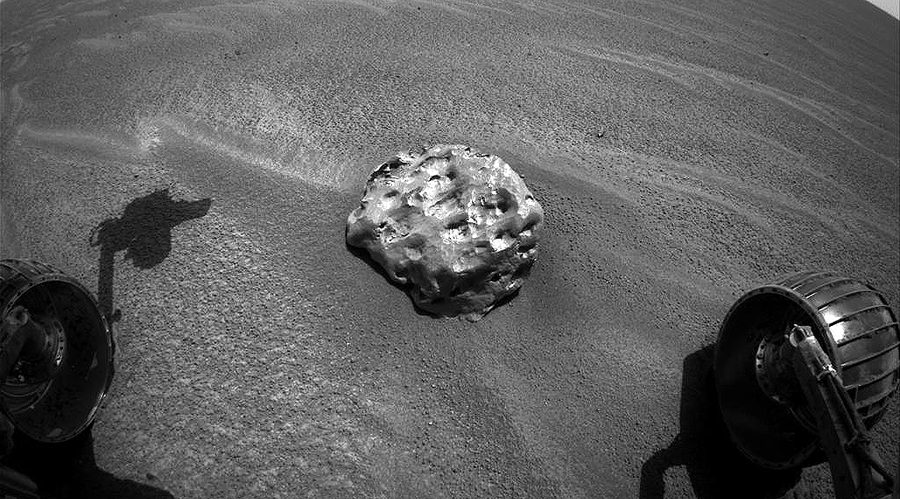
Mars rover Opportunity prepares to examine the Heat Shield Rock (Meteorito Meridiani Planum). File photo. © NASA / Wikipedia


Mars has been dry for an extraordinarily long time, according to new research. Such conclusions are based on studying rust-free meteorites which have been resting on the surface of the red planet.

The new research published on Thursday suggests that Mars has experienced“extreme aridity” for more than three billion years.

The research team studied the findings of the Mars Exploration Rover (MER) Opportunity, NASA’s robotic rover operating on the planet for the past 12 years. Opportunity studied a meteorite field, located on the Meridiani Planum plain, south of Mars’ equator.


2bn-yo water found deep underground offers clues to possible life on other planets

The search for possible life on the red planet revolves primarily around identifying the presence of water. New research suggests that life may have existed on Mars at some point in the distant past, perhaps sometime within the first billion years of its formation. The climate of the planet was presumably wetter and warmer, comparable to that of Earth in the time that the very first microbes emerged.

“Evidence shows that more than three billion years ago Mars was wet and habitable. However, this latest research reaffirms just how dry the environment is today. For life to exist in the areas we investigated, it would need to find pockets far beneath the surface, located away from the dryness and radiation present on the ground,” lead researcher, Dr. Christian Schroder, from the University of Stirling, said.

The scientists still endorse ‘follow the water’ approach, but according to the new data, it should be done deep underneath the surface of the red planet.

The team studied data on meteorites, and calculated how long it takes the metallic iron, present in them, to rust. The rusting process is dependent on atmospheric conditions and presence of water on the planet. The scientists found out that it takes iron to weather at least 10 and up to 10,000 times longer on Mars than in the driest deserts on the Earth.

“Such extreme aridity leads to a drop in the abundance of microbial life to below detection levels even on Earth, as documented for example in the Atacama desert in Chile,” states the research.

With that information, the scientists concluded that the surface of Mars have been an arid, cold and extremely unhospitable place for more than three billion years.

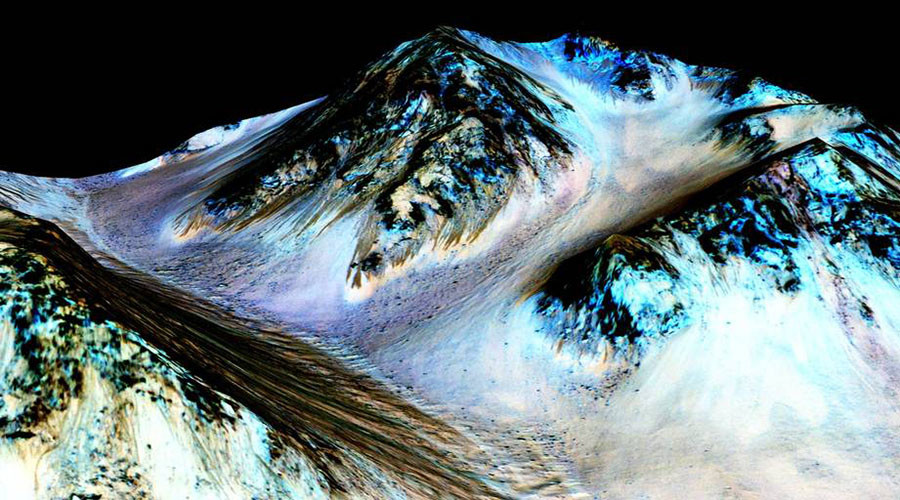
These dark, narrow, 100 meter-long streaks called recurring slope lineae flowing downhill on Mars are inferred to have been formed by contemporary flowing water. © NASA / JPL / University of Arizona / Reuters

The new research contradicts a study from last year, which suggested that liquid water probably contemporary flowed on the surface of the Mars. The 2015 study was based on data transmitted by Curiosity Rover from Gale crater. Another piece of research, published in July, was focused on so-called recurring slope lineae (RSL), seasonal features observed in the Valles Marineris region near Mars’ equator. One of the possible explanations of RSLs was “very limited flowing water”, which is also unlikely, according to the new research.

sábado, 5 de noviembre de 2016

NASA, FEMA Hold Asteroid Emergency Planning Exercise


NASA, FEMA Hold Asteroid Emergency Planning Exercise

Artist's concept of a near-Earth object. Image credit: NASA/JPL-Caltech

What would we do if we discovered a large asteroid on course to impact Earth? While highly unlikely, that was the high-consequence scenario discussed by attendees at an Oct. 25 NASA-FEMA tabletop exercise in El Segundo, California.

The third in a series of exercises hosted jointly by NASA and FEMA -- the Federal Emergency Management Agency -- the simulation was designed to strengthen the collaboration between the two agencies, which have Administration direction to lead the U.S. response. "It's not a matter of if -- but when -- we will deal with such a situation," said Thomas Zurbuchen, Associate Administrator for NASA's Science Mission Directorate in Washington. "But unlike any other time in our history, we now have the ability to respond to an impact threat through continued observations, predictions, response planning and mitigation."

The exercise provided a forum for the planetary science community to show how it would collect, analyze and share data about a hypothetical asteroid predicted to impact Earth. Emergency managers discussed how that data would be used to consider some of the unique challenges an asteroid impact would present-for preparedness, response and public warning.

"It is critical to exercise these kinds of low-probability but high-consequence disaster scenarios," FEMA Administrator Craig Fugate said. "By working through our emergency response plans now, we will be better prepared if and when we need to respond to such an event."

Exercise attendees included representatives from NASA, FEMA, NASA's Jet Propulsion Laboratory, the Department of Energy's National Laboratories, the U.S. Air Force, and the California Governor's Office of Emergency Services.

The exercise simulated a possible impact four years from now -- a fictitious asteroid imagined to have been discovered this fall with a 2 percent probability of impact with Earth on Sept. 20, 2020. The simulated asteroid was initially estimated to be between 300 and 800 feet (100 and 250 meters) in size, with a possibility of making impact anywhere along a long swath of Earth, including a narrow band of area that crossed the entire United States.

In the fictitious scenario, observers continued to track the asteroid for three months using ground-based telescope observations, and the probability of impact climbed to 65 percent. Then the next observations had to wait until four months later, due to the asteroid's position relative to the sun. Once observations could resume in May of 2017, the impact probability jumped to 100 percent. By November of 2017, it was simulated that the predicted impact would occur somewhere in a narrow band across Southern California or just off the coast in the Pacific Ocean.

While mounting a deflection mission to move the asteroid off its collision course had been simulated in previous tabletop exercises, this particular exercise was designed so that the time to impact was too short for a deflection mission to be feasible -- to pose a great future challenge to emergency managers faced with a mass evacuation of the metropolitan Los Angeles area.

Scientists from JPL, Lawrence Livermore National Laboratory, Sandia National Laboratories, and The Aerospace Corporation presented predicted impact footprint models, population displacement estimates, information on infrastructure that would be affected, as well as other data that could realistically be known at various points throughout the exercise scenario.

"The high degree of initial uncertainty coupled with the relatively long impact warning time made this scenario unique and especially challenging for emergency managers," said FEMA National Response Coordination Branch Chief Leviticus A. Lewis. "It's quite different from preparing for an event with a much shorter timeline, such as a hurricane."

Attendees considered ways to provide accurate, timely and useful information to the public, while also addressing how to refute rumors and false information that could emerge in the years leading up to the hypothetical impact.

"These exercises are invaluable for those of us in the asteroid science community responsible for engaging with FEMA on this natural hazard," said NASA Planetary Defense Officer Lindley Johnson. "We receive valuable feedback from emergency managers at these exercises about what information is critical for their decision making, and we take that into account when we exercise how we would provide information to FEMA about a predicted impact."

NASA provides expert input to FEMA about the asteroid impact hazard through the Planetary Defense Coordination Office. NASA and FEMA will continue to conduct asteroid impact exercises and intend to expand participation in future exercises to include additional representatives from local and state emergency management agencies and the private sector.

miércoles, 2 de noviembre de 2016

Laboratory in Pasadena, Calif. Think of Scout as a celestial intruder alert system

Laboratory in Pasadena, Calif. Think of Scout as a celestial intruder alert system.


A large space rock is going to come fairly close to Earth later tonight. Fortunately, it's not going to hit Earth, something astronomers are sure of thanks in part to a new tool NASA is developing for detecting potentially dangerous asteroids.

The tool is a computer program called Scout, and it's being tested at NASA Jet Propulsion Laboratory in Pasadena, Calif. Think of Scout as a celestial intruder alert system. It's constantly scanning data from telescopes to see if there are any reports of so-called Near Earth Objects. If it finds one, it makes a quick calculation of whether Earth is at risk, and instructs other telescopes to make follow-up observations to see if any risk is real.

NASA pays for several telescopes around the planet to scan the skies on a nightly basis, looking for these objects. "The NASA surveys are finding something like at least five asteroids every night," says astronomer Paul Chodas of JPL.

But then the trick is to figure out which new objects might hit Earth.

"When a telescope first finds a moving object, all you know is it's just a dot, moving on the sky," says Chodas. "You have no information about how far away it is. "The more telescopes you get pointed at an object, the more data you get, and the more you're sure you are how big it is and which way it's headed. But sometimes you don't have a lot of time to make those observations.

"Objects can come close to the Earth shortly after discovery, sometimes one day, two days, even hours in some cases," says JPL's Davide Farnocchia. "The main goal of Scout is to speed up the confirmation process."

The rock whizzing past Earth tonight was discovered on the night of Oct. 25-26 by the NASA-funded Panoramic Survey Telescope & Rapid Response System (Pan-STARRS) on Maui, Hawaii. Within a few hours, preliminary details about the object appeared on a web page maintained by the Minor Planet Center at the Smithsonian Astrophysical Observatory. Scout did a quick analysis of the preliminary details and determined that the object was headed for Earth, but would miss us by about 310,000 miles.

A telescope in Hawaii first spotted an errant rock headed toward Earth. The Scout program quickly flagged it for follow-up observations.

Additional observations by three telescopes, one operated by the Steward Observatory, another called Spacewatch, and a third at the Tenagra Observatories, confirmed the object would miss Earth by a comfortable margin. Astronomers were also able to estimate the size of the object: somewhere between 5 meters and 25 meters across. In case you're interested, full details about the object's trajectory can be found here.

Scout is still in the testing phase. It should become fully operational later this year.

Now Scout is mainly dealing with smallish, very nearby objects. Complementing Scout is another system which is already operational called Sentry.

Sentry's job is to identify objects large enough to wipe out a major city that might hit Earth in the next hundred years. "Our goal right now is to find 90 percent of the 140 meter asteroids and larger," says Chodas, but right now he estimates they're only able to find 25-30 percent of the estimated population of objects that size.

That number should get better when a new telescope being built in Chile called the Large Synoptic Survey Telescope comes on line. NASA is also considering a space telescope devoted to searching for asteroids.

OK, so let's say you find one of these monster rocks heading for Earth. What then? Astronomer Ed Lu says there is something you can do. He's CEO of an organization called B612. It's devoted to dealing with asteroid threats.

"If you know well in advance, and by well in advance I mean 10 years, 20 years, 30 years in advance which is something we can do, " says Lu, "then you can divert such an asteroid by just giving it a tiny nudge when it's many billions of miles from hitting the Earth."

NASA and the European Space Agency are developing a mission to practice doing just that.

Lu says in the last decade people who should worry about such things have begun to make concrete plans for dealing with dangerous asteroids.

"I believe in the next 10 to 15 years we'll actually be at the point where we as humans can say, 'Hey, we're safe from this danger of large asteroids hitting the Earth,' " he says.

In the meantime, we'll just have to hope that luck is on our side.

Scientists have previously suggested Mars may have a large number of meteorites because of its closeness to the Asteroid Belt.

The Mars Curiosity rover has found a small, smooth meteor on the surface of Mars that scientists have nicknamed the "egg rock" for its unusual shape.

It is not the first meteorite found on Mars, but it may be the most interesting. Calculated to be no more than 1.6 inches in diameter, the meteorite has a smooth surface that suggests it may have been melted, possibly as it entered Mars’ atmosphere, Universe Today reported.

Pictures of the meteorite taken Oct. 30 showed an egg-shaped meteor with a somewhat pitted surface indicative of melting and reforming. According to Earth Sky, chemical tests taken by the Curiosity rover showed the meteorite was made from metal, possibly from a nickel-iron mixture that is unlike other rocks and rock formations found on Mars.

Nickel-iron mixtures have been found in the cores of planets, and scientists from Arizona State University think it is likely the small meteorite may have come from the core of a dwarf planet that was formed by the compression of a large volume of cosmic dust, the Daily Mail reported.

Scientists have previously suggested Mars may have a large number of meteorites because of its closeness to the Asteroid Belt. It is thought that Mars may often be struck by objects that get kicked out of Jupiter’s gravity field.

Mars’ atmosphere is many times thinner than Earth’s, so objects that strike its surface may last a lot longer, with far less erosion than objects striking Earth’s surface.

It is conceivable that meteors could last millions of years on Mars because of the thin atmosphere, despite Mars’ often extreme weather patterns.

ALBUQUERQUE, Nov. 3 (UPI) - The Mars rover Curiosity has confirmed the identity of a small metallic globule, spotted last week by scientists in images captured by the rover's Mastcam. New chemical analysis suggests it is an iron-nickel meteorite.

"The dark, smooth and lustrous aspect of this target, and its sort of spherical shape attracted the attention of some MSL scientists when we received the Mastcam images at the new location," Pierre-Yves Meslin, an astrophysicist at the National Center for Scientific Research in France, explained in a press release.

Intrigued by the globule's appearance, scientists working on the Curiosity mission instructed the rover to analyze the object with its laser powered ChemCam. The instrument fired a series of laser pulses at the meteorite from various angles.

Initial readings suggest the presence of iron, nickel and phosphorus, a common trifecta in iron-nickel meteorites - evidence of its likely origin inside the molten core of a melting asteroid.

"Iron meteorites provide records of many different asteroids that broke up, with fragments of their cores ending up on Earth and on Mars," explained Horton Newsom, a scientist on the ChemCam team and a researcher at the University of New Mexico. "Mars may have sampled a different population of asteroids than Earth has."

Newsom, Meslin and other ChemCam team members are currently analyzing the results of the laser pulses bounced off Egg Rock. Researchers hope to compare the meteorite's surface composition to its insides in order to gauge how long it has been resting on the Martian surface, exposed to the elements. Scientists also want to compare Egg Rock to meteorite samples found elsewhere on Mars - and to meteorite samples from Earth.

In the meantime, Curiosity will continue its way up Mount Sharp in search of evidence of ancient environmental shifts on Mars.

Licencia de Creative Commons
El Misterio del Meteorito de Carancas by HERWARTH RONALD MORALES CHUMACERO is licensed under a Creative Commons Reconocimiento-SinObraDerivada 4.0 Internacional License.
Creado a partir de la obra en El Misterio del Meteorito de Carancas.